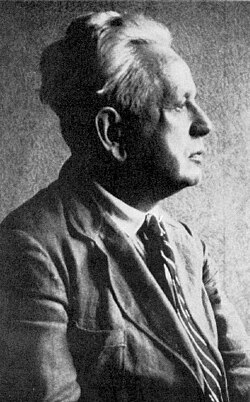
About Ernst Cassirer
Ernst Alfred Cassirer ( kah-SEER-ər, kə-; German: [ˈɛʁnst kaˈsiːʁɐ]; July 28, 1874 – April 13, 1945) was a German philosopher and historian of philosophy. Trained within the Marburg school of neo-Kantianism, he initially followed his mentor Hermann Cohen in attempting to supply an idealistic philosophy of science. After Cohen's death in 1918, Cassirer developed a theory of symbolism and used it to expand the "logic and psychology of thought" into a more general "logic of the cultural sciences". Cassirer was one of the leading 20th-century advocates of philosophical idealism. His most famous work is the Philosophy of Symbolic Forms (1923–1929). Though his work received a mixed reception shortly after his death, more recent scholarship has remarked upon Cassirer's role as a strident defender of the moral idealism of the Enlightenment era and the cause of liberal democracy at a time when the rise of fascism had made such advocacy unfashionable. Within the international Jewish community, Cassirer's work has additionally been seen as part of a long tradition of thought on ethical philosophy. == Biography == Cassirer was born in Breslau in Silesia (modern-day southwest Poland) into a Jewish family. After graduating from Johannesgymnasium Breslau, he studied Jurisprudence at Friedrich Wilhelm University of Berlin and Leipzig University, Germanic Philology, Contemporary Literary History, and Philosophy at Ruprecht Karl University of Heidelberg and Friedrich Wilhelm University of Berlin, and Philosophy and Psychology at the Ludwig-Maximilians-Universität München (LMU). He then did his doctoral work at the University of Marburg, where he studied Philosophy under Hermann Cohen and Paul Natorp and Mathematics under Friedrich Schottky.
Biography source: Wikipedia. The profile adds birthday-specific historical context from the Celebs Birthday Today editorial database.