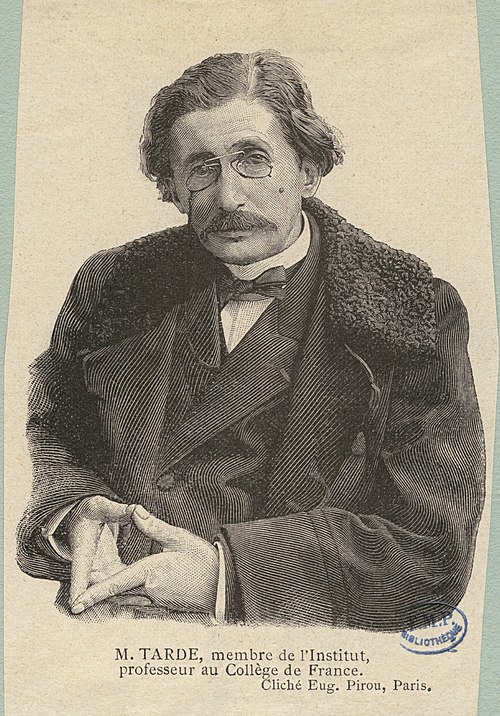
About Gabriel Tarde
Jean-Gabriel (de) Tarde (; French: [taʁd]; 12 March 1843 – 13 May 1904) was a French sociologist, criminologist and social psychologist who conceived sociology as based on small psychological interactions among individuals (much as if it were chemistry), the fundamental forces being imitation and innovation. == Life == Tarde was born and raised in Sarlat in the province of Dordogne. He studied law at Toulouse and Paris. From 1869 to 1894 he worked as a magistrate and investigating judge in the province. In the 1880s he corresponded with representatives of the newly formed criminal anthropology, most notably the Italians Enrico Ferri and Cesare Lombroso and the French psychiatrist Alexandre Lacassagne. With the latter, Tarde came to be the leading representative for a "French school" in criminology. In 1900 he was appointed professor in modern philosophy at the Collège de France. As such he was the most prominent contemporary critic of Durkheim's sociology. == Work == Among the concepts that Tarde initiated were the group mind (taken up and developed by Gustave Le Bon, and sometimes advanced to explain so-called herd behaviour or crowd psychology), and economic psychology, where he anticipated a number of modern developments. Tarde was very critical of Émile Durkheim's work at the level of both methodology and theory such as during the Tarde-Durkheim debate in 1903.
Biography source: Wikipedia. The profile adds birthday-specific historical context from the Celebs Birthday Today editorial database.