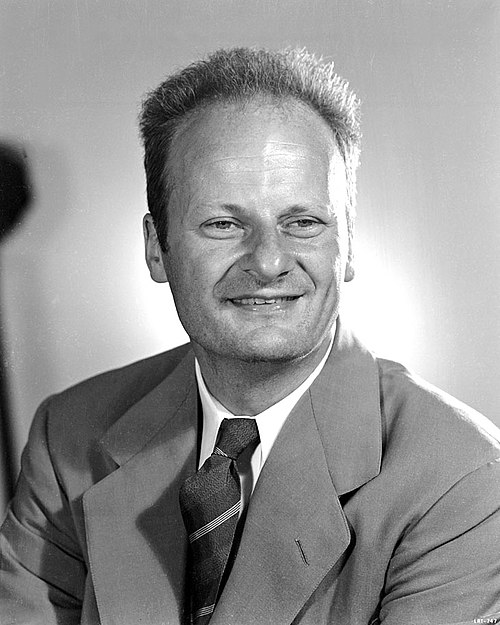
About Hans Bethe
Hans Albrecht Eduard Bethe (; German: [ˈhans ˈbeːtə]; 2 July 1906 – 6 March 2005) was a German-American physicist who made major contributions to nuclear physics, astrophysics, quantum electrodynamics and solid-state physics, and received the Nobel Prize in Physics in 1967 for his work on the theory of stellar nucleosynthesis. For most of his career, Bethe was a professor at Cornell University. In 1931, Bethe developed the Bethe ansatz, which is a method for finding the exact solutions for the eigenvalues and eigenvectors of certain one-dimensional quantum many-body models. In 1939, Bethe published a paper which established the CNO cycle as the primary energy source for heavier stars in the main sequence classification of stars, which earned him a Nobel Prize in 1967. During World War II, Bethe was head of the Theoretical Division at the secret Los Alamos National Laboratory that developed the first atomic bombs. There he played a key role in calculating the critical mass of the weapons and developing the theory behind the implosion method used in both the Trinity test and the "Fat Man" weapon dropped on Nagasaki in August 1945. After the war, Bethe played an important role in the development of the hydrogen bomb, as he also served as the head of the theoretical division for the project, although he had originally joined the project with the hope of proving it could not be made. He later campaigned with Albert Einstein and the Emergency Committee of Atomic Scientists against nuclear testing and the nuclear arms race. He helped persuade the Kennedy and Nixon administrations to sign, respectively, the 1963 Partial Nuclear Test Ban Treaty and 1972 Anti-Ballistic Missile Treaty (SALT I). In 1947, he wrote an important paper which provided the calculation of the Lamb shift, which is credited with revolutionizing quantum electrodynamics and further "opened the way to the modern era of particle physics". He contributed to the understanding of neutrinos and was key in the solving of the solar neutrino problem. He contributed to the understanding of supernovas and their processes. His scientific research never ceased, and he was publishing papers well into his nineties, making him one of the few scientists to have published at least one major paper in his field during every decade of his career, which in Bethe's case spanned nearly seventy years. Physicist Freeman Dyson, once his doctoral student, called him "the supreme problem-solver of the 20th century", and cosmologist Edward Kolb called him "the last of the old masters" of physics. At the request of Patrick Blackett, who was working with cloud chambers, Bethe created a relativistic version of the Bethe formula. Bethe later recalled that he became too ambitious, and, in pursuit of greater accuracy, his calculations became unnecessarily complicated.
Biography source: Wikipedia. The profile adds birthday-specific historical context from the Celebs Birthday Today editorial database.