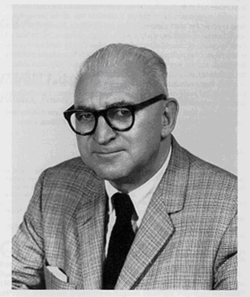
About Harold Lasswell
Harold Dwight Lasswell (February 13, 1902 – December 18, 1978) was an American political scientist and communications theorist. He was a professor of law at Yale University. He served as president of the American Political Science Association, American Society of International Law, and World Academy of Art and Science. According to a biographical memorial written by Gabriel Almond at the time of Lasswell's death, and published by the National Academies of Sciences in 1987, Lasswell "ranked among the half dozen creative innovators in the social sciences in the twentieth century." At the time, Almond asserted that "few would question that he was the most original and productive political scientist of his time." Areas of research in which Lasswell worked included the importance of personality, social structure, and culture in the explanation of political phenomena. Lasswell was associated with the disciplines of communication, political science, psychology, and sociology – however he did not adhere to the distinction between these boundaries, but instead worked to erase the lines drawn to divide these disciplines. Excelling in his academics, particularly history and English, Lasswell was awarded a scholarship to the University of Chicago. To institutionalize the policy sciences he was formulating, Lasswell along with Myres McDougal and George Dession created the Policy Sciences Council in 1944 and the Policy Sciences Foundation in 1948. Lasswell also used psychoanalytical interviewing and recording methods that he appropriated from his time of studying with Elton Mayo at Harvard University. In his 1956 presidential address to the American Political Science Association, Lasswell raised the question of whether or not we should give human rights to robots.
Biography source: Wikipedia. The profile adds birthday-specific historical context from the Celebs Birthday Today editorial database.