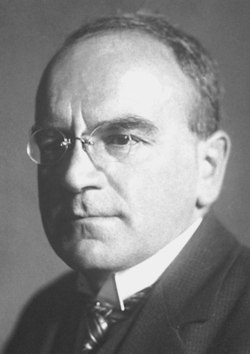
About Heinrich Otto Wieland
Heinrich Otto Wieland (German pronunciation: [ˈhaɪnʁɪç ˈviːlant]; 4 June 1877 – 5 August 1957) was a German chemist. He won the 1927 Nobel Prize in Chemistry for his research into the bile acids. == Career == In 1901, Wieland received his doctorate at the Ludwig-Maximilians-Universität München while studying under Johannes Thiele. In 1904 he completed his habilitation, then continued to teach at the university and starting in 1907 was a consultant for Boehringer Ingelheim. In 1914, he became associate professor for special topics in organic chemistry, and director of the Organic Division of the State Laboratory in Munich. From 1917 to 1918, Wieland worked in the service of the (KWI) Kaiser Wilhelm Institute for Physical Chemistry and Electrochemistry in Dahlem then led by Fritz Haber as an alternative to regular military service. There he was involved in weapons research for instance finding new synthetic routes for mustard gas. He is also credited with the first synthesis of Adamsite. From 1913 to 1921, he was Professor at the Technical University of Munich. He then moved to the University of Freiburg as successor of Ludwig Gattermann (he also assumed responsibility for Gattermann's famous cookbook).
Biography source: Wikipedia. The profile adds birthday-specific historical context from the Celebs Birthday Today editorial database.