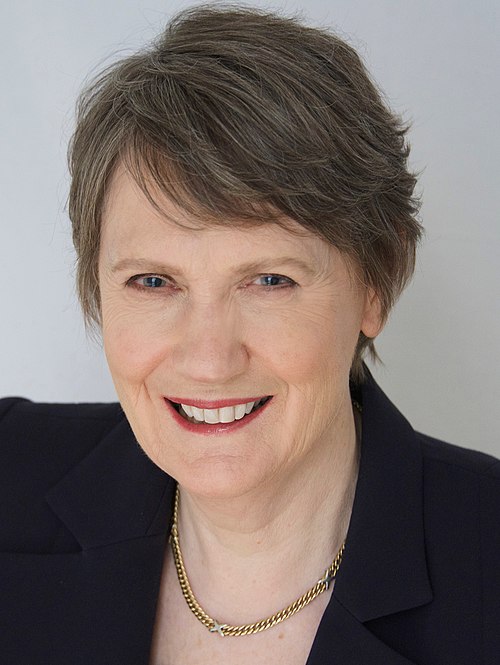
About Helen Clark
Helen Elizabeth Clark (born 26 February 1950) is a New Zealand politician who served as the 37th prime minister of New Zealand from 1999 to 2008 and was the administrator of the United Nations Development Programme from 2009 to 2017. She was New Zealand's fifth-longest-serving prime minister, and the second woman to hold that office. Clark was brought up on a farm outside Hamilton. She entered the University of Auckland in 1968 to study politics and became active in the New Zealand Labour Party. After graduating she lectured in political studies at the university. Clark entered local politics in 1974 in Auckland but was not elected to any position. Following one unsuccessful attempt, she was elected to Parliament in 1981 as the member for Mount Albert, an electorate she represented until 2009. Clark held numerous Cabinet positions in the Fourth Labour Government, including minister of housing, minister of health and minister of conservation. She was the 11th deputy prime minister of New Zealand from 1989 to 1990 serving under prime ministers Geoffrey Palmer and Mike Moore. After Labour's narrow defeat in the 1993 election, Clark challenged Moore for leadership of the party and won, becoming the leader of the Opposition. Following the 1999 election, Labour formed a governing coalition, and Clark was sworn in as prime minister on 10 December 1999. Clark led the Fifth Labour Government, which implemented several major economic initiatives including Kiwibank, the New Zealand Superannuation Fund, the New Zealand Emissions Trading Scheme and KiwiSaver. Her government also introduced the Foreshore and Seabed Act 2004, which caused major controversy. In foreign affairs, Clark sent troops to the Afghanistan War, but did not contribute combat troops to the Iraq War, and ordered deployment to the 2006 East Timorese crisis. She was ranked by Forbes as the 20th-most powerful woman in the world in 2006. She advocated a number of free-trade agreements with major trading partners, including becoming the first developed nation to sign such an agreement with China. After three successive electoral victories, her government was defeated in the 2008 election; Clark resigned as prime minister and party leader on 19 November 2008. She was succeeded as prime minister by John Key of the National Party, and as leader of the Labour Party by Phil Goff. Clark resigned from Parliament in April 2009 to become the first female head of the United Nations Development Programme (UNDP). In 2016, she stood for the position of secretary-general of the United Nations, but was unsuccessful. She left her UNDP administrator post on 19 April 2017 at the end of her second four-year term and was succeeded by Achim Steiner. In 2019, Clark became the patron of the Helen Clark Foundation.
Biography source: Wikipedia. The profile adds birthday-specific historical context from the Celebs Birthday Today editorial database.