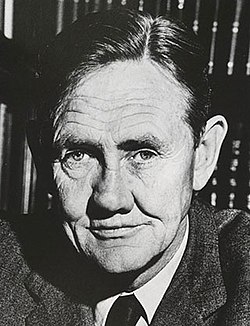
About John Gorton
Sir John Grey Gorton (9 September 1911 – 19 May 2002) was an Australian politician, farmer and airman who served as the 19th prime minister of Australia from 1968 to 1971. He held office as the leader of the Liberal Party of Australia, having previously served as a senator for Victoria. He was the first and only member of the upper house of the Parliament to assume the office of prime minister. Gorton was born out of wedlock and had a turbulent childhood. He studied at Brasenose College, Oxford, after finishing his secondary education at Geelong Grammar School, and then returned to Australia to take over his father's property in northern Victoria. Gorton enlisted in the Royal Australian Air Force in 1940, and was a fighter pilot in Malaya and New Guinea during the Second World War. He suffered severe facial injuries in a crash landing on Bintan Island in 1942, and whilst being evacuated, his ship was torpedoed and sunk by a Japanese submarine. Gorton returned to farming after being discharged in 1944, and was elected to the Kerang Shire Council in 1946; he later served a term as shire president. After a previous unsuccessful candidacy at state level, Gorton was elected to the Senate at the 1949 federal election. Gorton took a keen interest in foreign policy, and gained a reputation as a strident anti-Communist. Gorton was promoted to the ministry in 1958, and over the following decade held a variety of different portfolios in the governments of Sir Robert Menzies and Harold Holt. He was responsible at various times for the Royal Australian Navy, public works, education, and science. He was elevated to the Cabinet in 1966, and the following year, he was promoted to Leader of the Government in the Senate. Gorton defeated three other candidates for the Liberal leadership after Harold Holt's disappearance on 17 December 1967. He became the first and only senator to assume the office of Prime Minister, but soon transferred to the House of Representatives in Holt's vacant seat, in line with constitutional convention. His government continued Australian involvement in the Vietnam War, but began withdrawing troops amid growing public discontent. His government notably encouraged and fostered the re-establishment of the Australian film industry. Gorton retained office at the 1969 federal election in the Coalition's 20th year in office, albeit with a severely reduced majority. After alienating his party's right wing and following the resignation of Malcolm Fraser from his ministry, Gorton resigned as Liberal leader in March 1971 after a confidence motion in his leadership was tied, and was replaced by Billy McMahon. After losing the prime ministership, Gorton was elected deputy leader under McMahon and appointed Minister for Defence; he was sacked for disloyalty after a few months. After the Coalition's defeat at the 1972 federal election, Gorton unsuccessfully stood as McMahon's replacement. He briefly was an opposition frontbencher under Billy Snedden, but stood down in 1974 and spent the rest of his career as a backbencher. Notably, during this period Gorton moved the motion which decriminalised homosexuality federally and in the territories. Gorton resigned from the Liberal Party when Fraser was elected leader and he denounced the dismissal of the Whitlam government; at the 1975 election he mounted an unsuccessful campaign for the Senate as an Independent in the ACT and advocated for a Labor win. He later spent several years as a political commentator, retiring from public life in 1981. Gorton's domestic policies, which emphasised centralisation and economic nationalism, were often controversial in his own party, and his individualistic style alienated many of his Cabinet members. His political views widely varied and were incongruous, although he is generally regarded as having shifted further to the left over time after starting his parliamentary career on his party's hard right. Conservatively, he opposed Indigenous land rights, was opposed to an Australian Republic, was and at times fervently supported Australia developing nuclear weapons, but progressively, he staunchly supported drug decriminalisation, LGBT equality and reproductive rights. Evaluations of his prime ministership have been mixed; although he is generally ranked higher than either Holt or McMahon, Gorton is usually considered to have been a transitional prime minister who ultimately fell short of his potential for greatness.
Biography source: Wikipedia. The profile adds birthday-specific historical context from the Celebs Birthday Today editorial database.