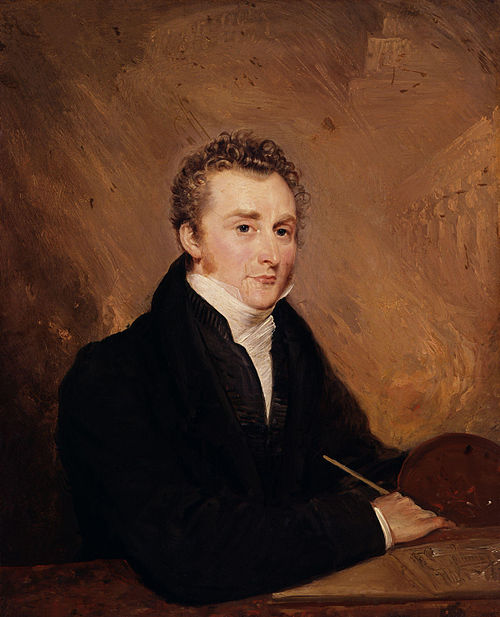
About John Martin (painter)
John Martin (19 July 1789 – 17 February 1854) was an English Romantic painter, engraver, and illustrator. He was known for his typically vast and dramatic paintings of religious subjects and fantastic compositions, populated with minute figures placed in imposing landscapes. Martin's paintings, and the prints made from them, enjoyed great success with the general public, with Thomas Lawrence referring to him as "the most popular painter of his day". He was also criticised by John Ruskin and other critics. == Early life == Martin was born in July 1789 in a one-room cottage, at Haydon Bridge, near Hexham in Northumberland, North East England. He was the fourth son of Fenwick Martin, former fencing master. He was apprenticed by his father to a coachbuilder in Newcastle upon Tyne to learn heraldic painting, but owing to a dispute over wages the indentures were cancelled, and he was placed instead under Boniface Musso, an Italian artist, father of the enamel painter Charles Muss. With his master, Martin moved from Newcastle to London in 1806, where he married at the age of nineteen. He supported himself by giving drawing lessons, and by painting in watercolours, as well as on china and glass — his only surviving painted plate is now in a private collection in England. In his leisure time, he studied perspective and architecture.
Biography source: Wikipedia. The profile adds birthday-specific historical context from the Celebs Birthday Today editorial database.