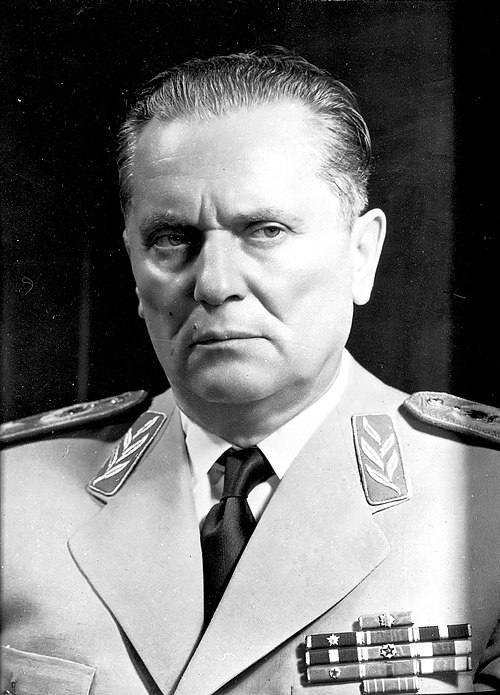
About Josip Broz Tito
Josip Broz (7 May 1892 – 4 May 1980), commonly known as Tito, was a Yugoslav communist revolutionary and politician who led Yugoslavia as prime minister from 1943 to 1963 and as president from 1953 until his death in 1980. He was the longtime leader of the League of Communists of Yugoslavia, supreme commander of the Yugoslav Partisans during World War II, and one of the founders of the Non-Aligned Movement. The political ideology and policies associated with his rule are known as Titoism. Tito was born in Kumrovec in present-day Croatia, then part of the Austro-Hungarian Empire. Drafted into military service, he distinguished himself, becoming the youngest sergeant major in the Austro-Hungarian Army. After being wounded and captured by the Russians during World War I, he was sent to a work camp in the Ural Mountains. Tito participated in the Russian Revolution in 1917 and the Russian Civil War. Upon his return to the Balkans in 1920, he entered the newly established Kingdom of Yugoslavia, where he joined the Communist Party of Yugoslavia. Having assumed control over the party by 1937, Tito became its general secretary in 1939 and led it until his death. During World War II, after the Axis invasion of Yugoslavia, he led the Yugoslav guerrilla movement, the Partisans (1941–1945), often regarded as the most effective resistance movement in German-occupied Europe. By the end of 1943, the Partisans, with the Allies' backing, took power in Yugoslavia. After the war, Tito served as the prime minister (1943–1963), president (1953–1980; from 1974 president for life), and marshal of Yugoslavia, the highest rank of the Yugoslav People's Army (JNA). Under Tito's leadership, Yugoslavia became a communist state, known from 1945 to 1963 as the Federal People's Republic of Yugoslavia and thereafter as the Socialist Federal Republic of Yugoslavia. Despite being a founder of the Cominform, his party became the first member—and he the only leader during Joseph Stalin's lifetime—to defy Soviet hegemony in the Eastern Bloc, resulting in Yugoslavia's expulsion from the organisation in 1948 in the Tito–Stalin split. Alongside other leaders and Marxist theorists such as Edvard Kardelj and Milovan Đilas, he initiated the idiosyncratic model of socialist self-management. Tito wavered between supporting a centralised or more decentralised federation, and ended up favouring the latter to keep ethnic tensions under control. Thus, the constitution delegated much power to each republic. A powerful cult of personality arose around him and was sustained for several years after his death. Following Tito's death, Yugoslavia's leadership was transformed into an annually rotating presidency, giving representation to all its nationalities, and to prevent an authoritarian leader. Twelve years later, as communism collapsed in Eastern Europe and ethnic tensions escalated, Yugoslavia broke into several independent states and descended into a decade of interethnic wars, the deadliest conflict in Europe's postwar history until the Russo-Ukrainian war. Historians critical of Tito view his presidency as authoritarian, while others characterise him as a benevolent dictator. He was popular in Yugoslavia and abroad, and remains so in the former countries of Yugoslavia. Tito was viewed as a unifying symbol, with his internal policies maintaining the peaceful coexistence of the nations of the Yugoslav federation. He gained further international attention as a co-founder of the Non-Aligned Movement. With a highly favourable reputation abroad in both Cold War blocs, he received a total of 98 foreign decorations, including the Legion of Honour and the Order of the Bath. Josip spent a significant proportion of his pre-school years living with his maternal grandparents at Podsreda, where he became a favourite of his grandfather Martin Javeršek.
Biography source: Wikipedia. The profile adds birthday-specific historical context from the Celebs Birthday Today editorial database.