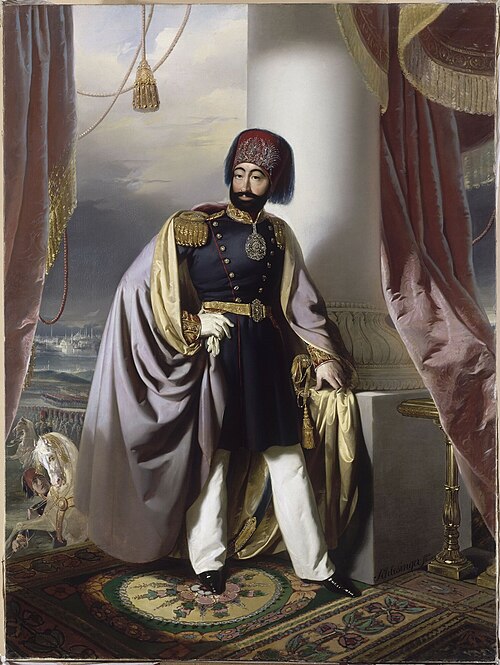
About Mahmud II
Mahmud II (Ottoman Turkish: محمود ثانى Maḥmûd-u s̠ânî; Turkish: II. Mahmud; 20 July 1785 – 1 July 1839) was the sultan of the Ottoman Empire from 1808 until his death in 1839. Often described as the "Peter the Great of Turkey", Mahmud instituted extensive administrative, military, and fiscal reforms. His disbandment of the conservative Janissary Corps removed a major obstacle to his and his successors' reforms in the Empire, creating the foundations of the subsequent Tanzimat era. Mahmud's reign was also marked by further Ottoman military defeats and loss of territory as a result of nationalist uprisings and European intervention. Mahmud ascended the throne following an 1808 coup that deposed his half-brother Mustafa IV. Early in his reign, the Ottoman Empire ceded Bessarabia to Russia at the end of the 1806–1812 Russo-Turkish War. Greece waged a successful war of independence that started in 1821 with British, French and Russian support, and Mahmud was forced to recognize the independent Greek state in 1832. The Ottomans lost more territory to Russia after the Russo-Turkish War of 1828–1829, and Ottoman Algeria was conquered by France beginning in 1830. The Empire's continued decline convinced Mahmud to resume the reforms that were halted before he came to power. In 1826, he orchestrated the Auspicious Incident, in which the Kapıkulu were forcibly abolished and many of its members executed, paving the way for the establishment of a modern Ottoman army and further military reforms. With this modern army, Sultan Mahmud initiated a campaign of recentralization in the empire that saw the submission of derebeys and ayans to central authority. He also made sweeping changes to the bureaucracy to reestablish royal authority and increase administrative efficiency. He oversaw a reorganisation of the Ottoman foreign office. In 1838, Mahmud established the Supreme Council of Judicial Ordinances, and the following year, he introduced a Council of Ministers. He died of tuberculosis later that year and was succeeded by his son Abdülmecid I, who would continue to implement his modernization efforts. The leader of this rebellion, Alemdar Mustafa Pasha, later became Mahmud II's vizier. The slave girl Cevri Kalfa was awarded for her bravery and loyalty and appointed as haznedar usta, chief treasurer of the Imperial Harem, which was the second most important position in the hierarchy. After Mahmud II became sultan, Turkish border wars with the Russians continued.
Biography source: Wikipedia. The profile adds birthday-specific historical context from the Celebs Birthday Today editorial database.