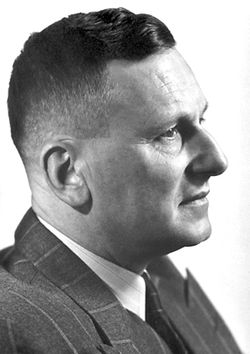
About Paul Hermann Müller
Paul Hermann Müller, also known as Pauly Mueller (12 January 1899 – 13 October 1965), was a Swiss chemist who received the 1948 Nobel prize in Physiology or Medicine for his 1939 discovery of insecticidal qualities and use of DDT in the control of vector diseases such as malaria and yellow fever. == Early life and education == Müller was born on 12 January 1899 in Olten, Solothurn, to Gottlieb and Fanny (née Leypoldt or Leypold) Müller. He was the oldest of four children. His father worked for the Swiss Federal Railways and the family first moved to Lenzburg in Aargau and then to Basel. Müller went to the local primary school (volksschule) and later to the lower and upper "realschule". In that time, he had a small laboratory where he developed photographic plates and built radio equipment. In 1916, he left school due to bad grades and started to work as a laboratory assistant at Dreyfus. The next year he became an assistant chemist in the scientific-industrial laboratory of the electrical plant of Lonza AG. Returning to school in 1918, he obtained his secondary school diploma in 1919 and entered the University of Basel in the same year. At the University of Basel he studied chemistry (with a minor in botany and physics) and started to study inorganic chemistry under Friedrich Fichter. In 1922, he continued his studies in the organic chemistry lab of Hans Rupe.
Biography source: Wikipedia. The profile adds birthday-specific historical context from the Celebs Birthday Today editorial database.