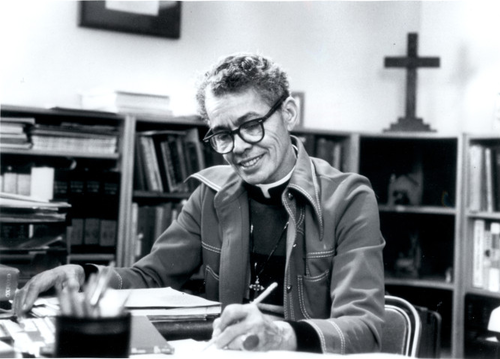
About Pauli Murray
Anna Pauline "Pauli" Murray (November 20, 1910 – July 1, 1985) was an American civil rights activist, advocate, legal scholar and theorist, author and – later in life – an Episcopal priest. Murray's work influenced the civil rights movement and expanded legal protection for gender equality. Born in Baltimore, Maryland, Murray was essentially orphaned and then raised mostly by her maternal aunt in Durham, North Carolina. At age 16, she moved to New York City to attend Hunter College, and graduated with a Bachelor of Arts degree in English in 1933. In 1940, Murray sat in the whites-only section of a Virginia bus with a friend, and they were arrested for violating state segregation laws. This incident, and her subsequent involvement with the socialist Workers' Defense League, led her to pursue her career goal of working as a civil rights lawyer. She enrolled in the law school at Howard University, where she was the only woman in her class. Murray graduated first in the class of 1944, but she was denied the chance to do post-graduate work at Harvard University because of her gender. She called such prejudice against women "Jane Crow", alluding to the Jim Crow laws that enforced racial segregation in the Southern United States. She received a fellowship from the Rosenwald Fund which enabled her to earn a master's degree in law at University of California, Berkeley. In 1965 she became the first African American to receive a Doctor of Juridical Science degree from Yale Law School. As a lawyer, Murray argued for civil rights and women's rights. National Association for the Advancement of Colored People (NAACP) Chief Counsel Thurgood Marshall called Murray's 1950 book States' Laws on Race and Color, the "bible" of the civil rights movement. Murray was appointed by President John F. Kennedy to serve on the 1961–1963 Presidential Commission on the Status of Women. In 1966, she was a co-founder of the National Organization for Women. Ruth Bader Ginsburg named Murray as a coauthor of the ACLU brief in the landmark 1971 Supreme Court case Reed v. Reed, in recognition of her pioneering work on gender discrimination. This case articulated the "failure of the courts to recognize sex discrimination for what it is and its common features with other types of arbitrary discrimination." Murray held faculty or administrative positions at the Ghana School of Law, Benedict College, and Brandeis University. In 1973, Murray left academia for activities associated with the Episcopal Church. She became an ordained priest in 1977, among the first generation of women priests and the first African-American woman to be ordained as an Episcopal priest. In addition to her legal and advocacy work, Murray published two well-reviewed autobiographies and a volume of poetry. Initially published in 1970, the poetry collection, Dark Testament, was reissued in 2018. Murray's sexual and gender identity did not fit within the prevailing norms. She had a brief, annulled marriage to a man, and several deep relationships with women. In her younger years, she occasionally had passed as a teenage boy. She earned a master's degree in law at University of California, Berkeley, and in 1965 she became the first African American to receive a Doctor of Juridical Science degree from Yale Law School.
Biography source: Wikipedia. The profile adds birthday-specific historical context from the Celebs Birthday Today editorial database.