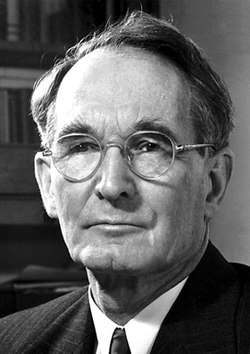
About Percy Williams Bridgman
Percy Williams Bridgman (April 21, 1882 – August 20, 1961) was an American physicist who received the Nobel Prize in Physics in 1946 for his work on the physics of high pressures. He also wrote extensively on the scientific method and on other aspects of the philosophy of science. The Bridgman effect, the Bridgman–Stockbarger technique, and the high-pressure mineral bridgmanite are named after him. == Early life and education == Percy Williams Bridgman was born on April 21, 1882, in Cambridge, Massachusetts, and grew up in nearby Auburndale. His parents were both born in New England. His father, Raymond Landon Bridgman, was "profoundly religious and idealistic" and worked as a newspaper reporter assigned to state politics. His mother, Mary Ann Maria Williams, was described as "more conventional, sprightly, and competitive." Bridgman attended both elementary and high school in Auburndale, where he excelled at competitions in the classroom, on the playground, and while playing chess. Described as both shy and proud, his home life consisted of family music, card games, and domestic and garden chores. The family was deeply religious; reading the Bible each morning and attending a Congregational Church. However, Bridgman later became an atheist.
Biography source: Wikipedia. The profile adds birthday-specific historical context from the Celebs Birthday Today editorial database.