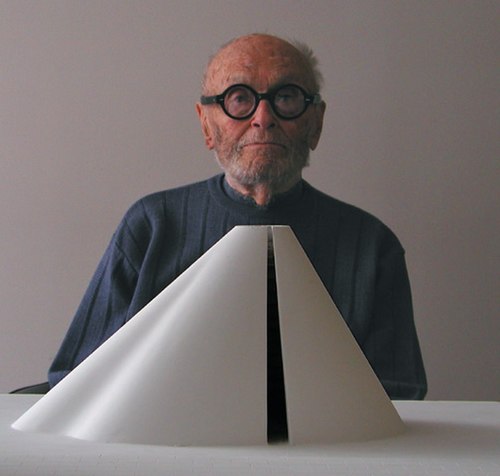
About Philip Johnson
Philip Cortelyou Johnson (July 8, 1906 – January 25, 2005) was an American architect who designed modern and postmodern architecture. Among his best-known designs are his modernist Glass House in New Canaan, Connecticut; the postmodern 550 Madison Avenue in New York City, designed for AT&T; 190 South La Salle Street in Chicago; IDS Tower in downtown Minneapolis; the Sculpture Garden of New York City's Museum of Modern Art; the postmodern Williams Tower in Houston, Texas; and the Pre-Columbian Pavilion at Dumbarton Oaks. His January 2005 obituary in The New York Times described his works as being "widely considered among the architectural masterpieces of the 20th century". In 1930, Johnson became the first director of the architecture department of the Museum of Modern Art in New York. There he arranged for visits by Walter Gropius and Le Corbusier and negotiated the first American commission for Mies van der Rohe, after he fled Nazi Germany. In 1932, he organized with Henry-Russell Hitchcock the first exhibition dedicated to modern architecture at the Museum of Modern Art, which gave name to the subsequent movement known as International Style. In 1934, Johnson resigned his position at the museum. During the 1930s, Johnson became an ardent admirer of Adolf Hitler, openly praised the Nazi Party, and espoused antisemitic views. He wrote for Social Justice and Examiner, where he published an admiring review of Hitler's Mein Kampf. In 1939, as a correspondent for Social Justice, he witnessed Hitler's invasion of Poland, which he later described as "a stirring spectacle". In 1941, after the U.S. entered the war, Johnson abruptly renounced his earlier views, quit journalism, and organized an anti-Fascist league at Harvard Design School. He was investigated by the FBI, and was eventually cleared for military service. He evaded indictment and jail by cooperating with the prosecution, though, according to some critics, it may have been because of his social connections; no evidence of this was ever produced. Years later he would refer to these activities as "the stupidest thing I ever did [which] I never can atone for". In 1978, he was awarded an American Institute of Architects Gold Medal. In 1979, he was the first recipient of the Pritzker Architecture Prize. Today his skyscrapers are prominent features in the skylines of New York, Houston, Chicago, Detroit, Minneapolis, Pittsburgh, Atlanta, Madrid, and other cities.
Biography source: Wikipedia. The profile adds birthday-specific historical context from the Celebs Birthday Today editorial database.