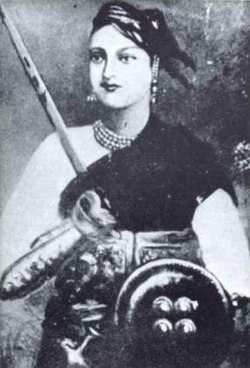
About Rani of Jhansi
The Rani of Jhansi (Hindi: Jhānsi Ki Rāni; born Manikarnika Tambe; 1827–30, or 1835 – 18 June 1858), also known as Rani Lakshmibai, was one of the leading figures of the Indian Rebellion of 1857. The queen consort of the princely state of Jhansi from 1843 to 1853, she assumed its leadership after the outbreak of the conflict and fought several battles against the British. Her life and deeds are celebrated in modern India and she remains a potent symbol of Indian nationalism. Born into a Marathi family in Varanasi, Manikarnika Tambe was married to the raja of Jhansi, Gangadhar Rao, at a young age, taking the name Rani Lakshmibai. The couple had one son but he died young, and so when Gangadhar Rao was on his deathbed in 1853, he adopted Damodar Rao, a young relative, to be his successor. The British East India Company, which by then had subjugated much of India, including Jhansi, refused to recognise this succession and annexed Jhansi under the Doctrine of Lapse, ignoring the Rani's vigorous protests to the Governor-General Lord Dalhousie. In May 1857, the Indian troops stationed at Jhansi mutinied and massacred most of the British in the town; the Rani's complicity and participation in these events was and remains contested. She took over the rulership of Jhansi and recruited an army to see off incursions from neighbouring states. Although her relations with the British were initially neutral, they decided to treat her as an enemy: Major General Hugh Rose attacked and captured Jhansi in March and April 1858. The Rani escaped the siege on horseback and joined other rebel leaders at Kalpi, where Rose defeated them on 22 May. The rebels fled to Gwalior Fort, where they made their last stand; the Rani died there in battle. After the rebellion, the Rani's name and actions became closely associated with nationalist movements in India. Her legend, influenced by Hindu mythology, became hugely influential because of its universal applicability. She was regarded as a great heroine by the Indian independence movement and remains revered in modern India, although Dalit communities tend to view her negatively. Rani Lakshmibai has been extensively depicted in artwork, cinema, and literature, most notably in the 1930 poem "Jhansi Ki Rani" and Vrindavan Lal Verma's 1946 novel Jhansi Ki Rani Lakshmibai.
Biography source: Wikipedia. The profile adds birthday-specific historical context from the Celebs Birthday Today editorial database.