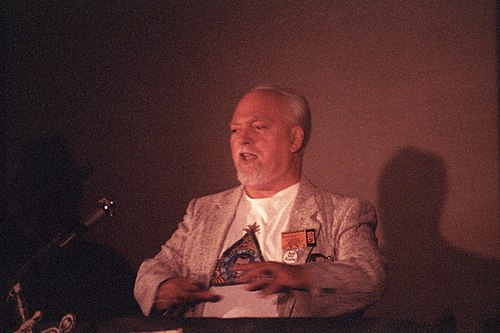
About Robert Anton Wilson
Robert Anton Wilson (born Robert Edward Wilson; January 18, 1932 – January 11, 2007) was an American writer, futurist, psychologist, and self-described agnostic mystic. Recognized within Discordianism as an Episkopos, pope and saint, Wilson helped publicize Discordianism through his writings and interviews. In 1999 he described his work as an "attempt to break down conditioned associations, to look at the world in a new way, with many models recognized as models or maps, and no one model elevated to the truth". Wilson's goal was "to try to get people into a state of generalized agnosticism, not agnosticism about God alone but agnosticism about everything." In addition to writing several science-fiction novels, Wilson also wrote non-fiction books on extrasensory perception, mental telepathy, metaphysics, paranormal experiences, conspiracy theory, sex, drugs, and what Wilson called "quantum psychology". Following a career in journalism and as an editor, notably for Playboy, Wilson emerged as a countercultural figure in the mid-1970s, alongside one of his coauthors, Timothy Leary, as well as Terence McKenna. == Life == Born Robert Edward Wilson in Methodist Hospital, in Brooklyn, New York, he spent his first years in Flatbush, and moved with his family to Gerritsen Beach, in a lower middle class area, around the age of four or five, where they stayed until relocating to the then-socioeconomically analogous South Slope section (in part to facilitate an easier high school commute for Wilson) when he was thirteen. He had polio as a child, and found generally effective treatment with the Kenny Method (created by Elizabeth Kenny) which the American Medical Association repudiated at that time. Polio's effects remained with Wilson throughout his life, usually manifesting as minor muscle spasms causing him to occasionally use a cane, until 2000, when he experienced a major bout with post-polio syndrome that would continue until his death. He attended Catholic grammar schools before securing admission to the selective Brooklyn Technical High School. Removed from the Catholic influence at "Brooklyn Tech", Wilson became enamored of literary modernism (particularly Ezra Pound and James Joyce), the Western philosophical tradition, then-innovative historians such as Charles A. Beard, science fiction (including the works of Olaf Stapledon, Robert A. Heinlein and Theodore Sturgeon) and Alfred Korzybski's interdisciplinary theory of general semantics.
Biography source: Wikipedia. The profile adds birthday-specific historical context from the Celebs Birthday Today editorial database.