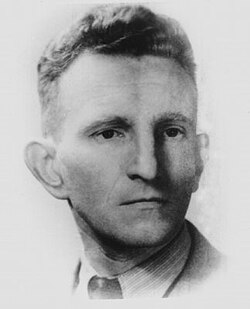
About Roman Shukhevych
Roman-Taras Osypovych Shukhevych (Ukrainian: Роман-Тарас Осипович Шухевич, also known by his pseudonym, Tur and Taras Chuprynka; 30 June 1907 – 5 March 1950) was a Ukrainian nationalist and a military leader of the nationalist Ukrainian Insurgent Army (UPA), which during the Second World War fought against the Soviet Union and to a lesser extent against Nazi Germany for Ukrainian independence. He collaborated with the Nazis from February 1941 to December 1942 as commanding officer of the Nachtigall Battalion in early 1941, and as a Hauptmann of the German Schutzmannschaft 201 auxiliary police battalion in late 1941 and 1942. Shukhevych led some of the Galicia-Volhynia massacres, where tens of thousands of Polish civilians were killed. It is unclear to what extent Shukhevych was responsible for the massacres of Poles in Volhynia, but he condoned them afterwards, and directed the murders of Poles in Eastern Galicia. Historian Per Anders Rudling has accused the Ukrainian diaspora and Ukrainian academics of "ignoring, glossing over, or outright denying" OUN's role in the massacres. == Life == Shukhevych was born in the city of Lemberg (now Lviv), in the Galicia region of Austria-Hungary (some sources claim his place of birth as Krakovets). He studied at the Lviv Academic Gymnasium, living with his grandfather, Volodymyr Shukhevych, an ethnographer. His political formation was influenced by Yevhen Konovalets, the commander of the Ukrainian Military Organization, who rented a room in Yevhen Konovalets's father's house from 1921 to 1922. === Education === In October 1926, Shukhevych entered the Lviv Polytechnic Institute (then Politechnika Lwowska – when the city of Lwów was part of the Second Polish Republic) to study civil engineering. In July 1934 he completed his studies with an engineering degree in road-bridge speciality.
Biography source: Wikipedia. The profile adds birthday-specific historical context from the Celebs Birthday Today editorial database.