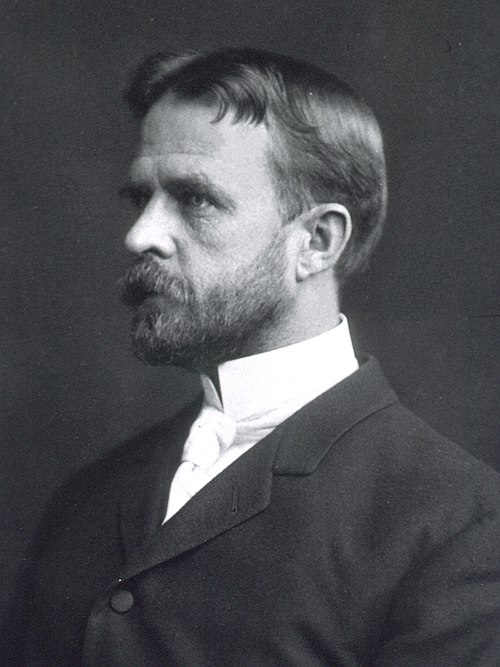
About Thomas Hunt Morgan
Thomas Hunt Morgan (September 25, 1866 – December 4, 1945) was an American evolutionary biologist, geneticist, and embryologist. In 1933, he won the Nobel Prize in Physiology or Medicine for discoveries on the role of chromosomes in heredity. Morgan received his Ph.D. from Johns Hopkins University in zoology in 1890 and researched embryology during his tenure at Bryn Mawr. Following the rediscovery of Mendelian inheritance in 1900, Morgan began to study the genetic characteristics of the fruit fly Drosophila melanogaster. In his famous Fly Room at Columbia University's Schermerhorn Hall, Morgan demonstrated that genes are carried on chromosomes and are the mechanical basis of heredity. These discoveries formed the basis of the modern science of genetics. During his distinguished career, Morgan wrote 22 books and 370 scientific papers. As a result of his work, Drosophila became a major model organism in contemporary genetics. The Division of Biology which he established at the California Institute of Technology has produced seven Nobel Prize winners. Following a summer at the Marine Biology School in Annisquam, Massachusetts, Morgan began graduate studies in zoology at the recently founded Johns Hopkins University. The college offered Morgan a full professorship; however, he chose to stay at Johns Hopkins and was awarded a relatively large fellowship to help him fund his studies. Part of a line of Southern plantation and slave owners on his father's side, Morgan was a nephew of Confederate General John Hunt Morgan; his great-grandfather John Wesley Hunt had been one of the first millionaires west of the Allegheny Mountains.
Biography source: Wikipedia. The profile adds birthday-specific historical context from the Celebs Birthday Today editorial database.