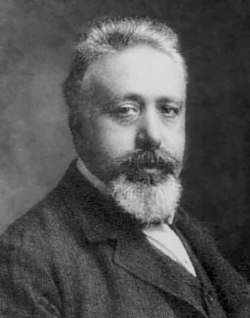
About Vito Volterra
Vito Volterra (, Italian: [ˈviːto volˈtɛrra]; 3 May 1860 – 11 October 1940) was an Italian mathematician and physicist, known for his contributions to mathematical biology and integral equations, being one of the founders of functional analysis. == Biography == Born in Ancona, then part of the Papal States, into a very poor Jewish family: his father was Abramo Volterra and his mother, Angelica Almagià. Abramo Volterra died in 1862 when Vito was two years old. The family moved to Turin, and then to Florence, where he studied at the Dante Alighieri Technical School and the Galileo Galilei Technical Institute. Volterra showed early promise in mathematics before attending the University of Pisa, where he fell under the influence of Enrico Betti, and where he became professor of rational mechanics in 1883. He immediately started work developing his theory of functionals which led to his interest and later contributions in integral and integro-differential equations. His work is summarised in his book Theory of functionals and of Integral and Integro-Differential Equations (1930). In 1892, he became professor of mechanics at the University of Turin and then, in 1900, professor of mathematical physics at the University of Rome La Sapienza. Volterra had grown up during the final stages of the Risorgimento when the Papal States were finally annexed by Italy and, like his mentor Betti, he was an enthusiastic patriot, being named by the king Victor Emmanuel III as a senator of the Kingdom of Italy in 1905. In the same year, he began to develop the theory of dislocations in crystals that was later to become important in the understanding of the behaviour of ductile materials.
Biography source: Wikipedia. The profile adds birthday-specific historical context from the Celebs Birthday Today editorial database.