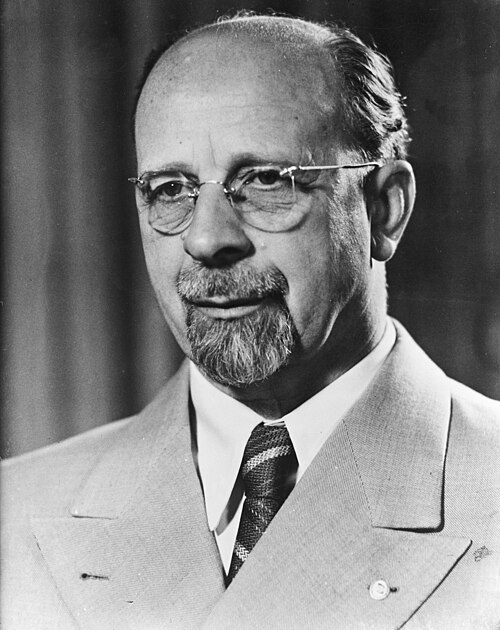
About Walter Ulbricht
Walter Ernst Paul Ulbricht was a German communist politician. Ulbricht played a leading role in the creation of the Weimar-era Communist Party of Germany (KPD) and later in the early development and establishment of the German Democratic Republic. As the First Secretary of the Communist Socialist Unity Party from 1950 to 1971, he was the chief decision-maker in East Germany. From President Wilhelm Pieck's death in 1960, he was also the East German head of state until his own death in 1973. As the leader of a significant Communist satellite, Ulbricht had a degree of bargaining power with the Kremlin that he used effectively. For example, he demanded the building of the Berlin Wall in 1961 when the Kremlin was reluctant. He became the First Secretary of the SED and effective leader of the recently established East Germany in 1950. Ulbricht began his political life during the German Empire, when he joined first the Social Democratic Party of Germany (SPD) in 1912 later joining the anti-World War I Independent Social Democratic Party of Germany (USPD) in 1917. The failures of Ulbricht's New Economic System and Economic System of Socialism from 1963 to 1970 led to his forcible retirement for "health reasons" and replacement as First Secretary in 1971 by Erich Honecker with Soviet approval.
Biography source: Wikipedia. The profile adds birthday-specific historical context from the Celebs Birthday Today editorial database.