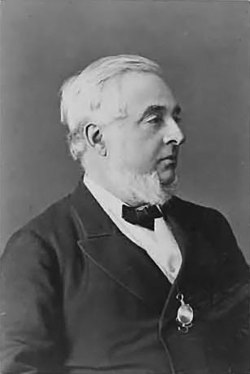
About Warren De la Rue
Warren De la Rue (18 January 1815 – 19 April 1889) was a British astronomer, chemist, and inventor, most famous for his pioneering work in astronomical photography. == Biography == He was born in Guernsey on the Channel Islands, the son of the founder of the large firm of stationers of that name in London, Thomas de la Rue and Jane (née Warren). Having completed his education at the Collège Sainte-Barbe in Paris, he entered his father's business, but devoted his leisure hours to chemical and electrical researches, and between 1836 and 1848 published several papers on these subjects. In 1840, he enclosed a platinum coil in a vacuum tube and passed an electric current through it, thus creating one of the world's first electric light bulbs. The design was based on the concept that the high melting point of platinum would allow it to operate at high temperatures and that the evacuated chamber would contain fewer gas molecules to react with the platinum, improving its longevity. Although it was an efficient design, the cost of the platinum made it impractical for commercial use. Attracted to astronomy by the influence of James Nasmyth, he constructed in 1850 a 13-inch reflecting telescope, mounted first at Canonbury, later at Cranford, Middlesex, and with its aid executed many drawings of the celestial bodies of singular beauty and fidelity. His chief title to fame is his pioneering work in the application of the art of photography to astronomical research. In 1851 his attention was drawn to a daguerreotype of the moon by G. P. Bond, shown at the great exhibition of that year. Excited to emulate and employ the more rapid wet-collodion process, he succeeded before long in obtaining exquisitely defined lunar pictures, which remained unsurpassed until the appearance of the Lewis Morris Rutherfurd photographs in 1865.
Biography source: Wikipedia. The profile adds birthday-specific historical context from the Celebs Birthday Today editorial database.