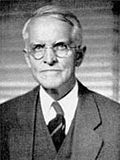
About Wesley Clair Mitchell
Wesley Clair Mitchell (August 5, 1874 – October 29, 1948) was an American economist known for his empirical work on business cycles and for guiding the National Bureau of Economic Research in its first decades. Mitchell was referred to as Thorstein Veblen's "star student." Paul Samuelson named Mitchell (along with Harry Gunnison Brown, Allyn Abbott Young, Henry Ludwell Moore, Frank Knight, Jacob Viner, and Henry Schultz) as one of the several "American saints in economics" born after 1860. == Biography == Mitchell was born in Rushville, Illinois, the second child and oldest son of a Civil War army doctor turned farmer. In a family with seven children and a disabled father with an appetite for business ventures "verging on rashness" a lot of responsibility fell on the oldest son. Despite these challenges, Wesley Clair went to study at the University of Chicago and was awarded a PhD in 1899. Mitchell's career as a researcher and teacher took the following course: instructor in economics at Chicago (1899–1903), assistant professor (1903–08) and professor (1909–12) of economics at the University of California, Berkeley, visiting lecturer at Harvard University (1908–09), lecturer (1913) and full professor (1914–44) at Columbia University. In 1916 he was elected as a Fellow of the American Statistical Association. He was elected to both the American Academy of Arts and Sciences and the American Philosophical Society in 1931. He was one of the founders of the New School for Social Research, where he taught for a time between 1919 and 1922, and of the National Bureau of Economic Research (1920), where he was director of research until 1945. There was an interruption for government service during the First World War, when Mitchell served as chief of price statistics in the planning and statistics division of the War Industries Board, working with Isador Lubin, Walter Stewart and Leo Wolman.
Biography source: Wikipedia. The profile adds birthday-specific historical context from the Celebs Birthday Today editorial database.